


As generative music turns catalogues into APIs, the winning business model will not be policing every output, it will be pricing every authorized transformation.
Sony Music Publishing agreed on May 11 to acquire Blackstone's Recognition Music Group catalogue of over 45,000 songs, in a deal valued at roughly $4 billion. The catalogue includes hits like Journey's "Don't Stop Believin'," Fleetwood Mac's "Go Your Own Way," Beyoncé's "Single Ladies," Rihanna's "Umbrella," Lady Gaga's "Bad Romance," and Leonard Cohen's "Hallelujah", assets Blackstone had assembled largely through its earlier Hipgnosis acquisitions.
It was largely reported as another multibillion-dollar vote of confidence in catalogue as an asset class. But it was also something stranger. The trade press read it as a catalogue story. It is also an AI story. It was a bet that in five years, the most valuable thing a major can own will not be a song. It will be the right to license its mutations.
The catalogue is becoming a function, not a file.
The Inversion No One Has Metabolized
Two camps have spent the last three years arguing past each other. One says generative music is theft and must be stopped. The other says training data is fair use and no compensation is owed. Both are wrong, not because their values are wrong, but because the framing is. There are no sides in this. There are only players, and players adapt to the rules of the new game.
The old game-theory lesson applies. People pirate because there is no authorized alternative. Give them one, frictionless, cheap, attributable and piracy collapses on economics alone. The post-Napster lesson, from iTunes to Spotify, was that authorized convenience beats pirated friction. The generative AI lesson will be that upstream licensing beats downstream litigation.
The music business spent a century perfecting the economics of scarcity. A small head of hits drove the majority of revenue. Distribution was the moat. Enforcement was a matching problem against a finite catalogue. Streaming did not break that model; it intensified it. The head got bigger. Generative music breaks it.
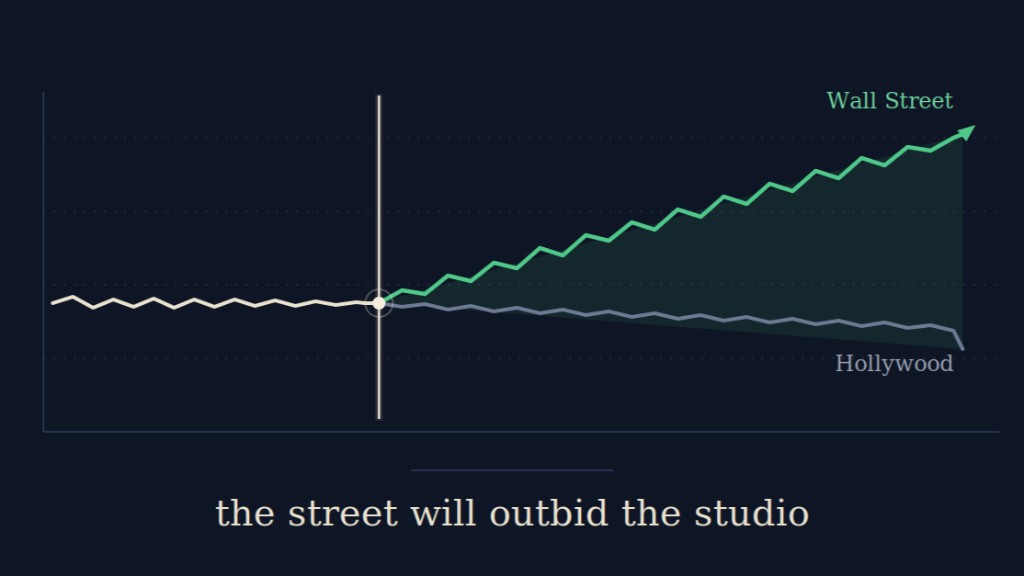
For the first time, supply is combinatorial rather than catalogued. A single prompt yields a 145-BPM, heart-rate-synced, Carpenter-adjacent workout track that has never existed before and will never exist again. Multiply by every listener, every workout, every commute. You cannot index what has not yet been generated, and you cannot litigate a mutation that lasts ninety seconds. Content ID was built on the assumption that infringement is a matching problem against a known corpus. This cannot be the primary control point for a world of infinite, personalized, ninety-second mutations. The control point must move upstream: into permissions, model access, provenance, and metering.
The conventional read is that the tail swallows the head. The truer read is that the head fractures. One half becomes a metered utility, software-defined, adaptive, biometric-aware, sold by the minute. The other half becomes a luxury good, engineered scarcity, verifiable human origin, premium-priced. They will not compete; they will run on different rails inside the same companies, with different margins and different KPIs. Confusing them is the most expensive mistake an executive can make this decade.
Through this lens, the catalogue investors the trade press has spent two years questioning, start to look considerably smarter. Blackstone on Hipgnosis. Pophouse on ABBA. Concord's wider roll-up. The dozens of songwriter-share deals. These are not nostalgia plays. They are options on both heads buying the latent space, the verified human-attested core, and the rights footprint that will license the generators. The deal is the API for culture.
But the catalogue thesis only gets you halfway. Within three years, the first nine-figure acquisition in music will not be a catalogue. It will be a model company.
A Bill of Materials for Sound
If the head fractures, the enforcement problem inverts with it. The control point must move upstream, before generation, to the model itself. Modern software ships with a bill of materials proving what is inside; music needs the equivalent. Licensed training data with verifiable lineage. Permissioned access to an artist's latent style space. Edge-level enforcement as inference moves onto local silicon, where Apple, Qualcomm, and the Android silicon roadmap are already racing. Bind those layers together with C2PA manifests and Merkle-tree provenance, and every mutation carries a tamper-evident chain of custody.
The last pieces of the puzzle are being put in place as we speak: neural watermarks that survive transcoding, immutable statistical derivation engines, cryptographic Merkle trees for lineage detection, rights registries, pricing engines on Stripe rails and Agents that take care of the orchestration. It sounds complicated but most of the AI-native tech stack is already being developed, and the complexity will be hidden for the consumer.
Think of it as a software bill of materials (SBOM) but for sound — every note, stem, and style vector traceable to its licensed origin.
We do not need to scan the internet. We need to verify the root hash.
The Transformation Royalty
This is where the business model starts to appear. Universal Music Group and Udio have already moved from litigation to a licensed AI music platform trained on authorized music; Warner Music Group followed with UDIO, then with Suno; and KLAY announced separate AI licensing deals with Universal, Sony and Warner. The market signal is clear: lawsuits are establishing the boundary, but licensing is beginning to define the product.
Let's call it a transformation royalty or, at the level of industry architecture, a transformation tax on the infinite tail. Using usage-based billing rails, of which Stripe's agentic-payments work is the cleanest example in the market, every generative play becomes a micro-transaction routed to rights-holders in real time. We will just pay a subscription price which contains a token budget for the transformations we want to see happen. The unauthorized version offers no fidelity advantage, no biometric sync, no provenance, and no social cachet. The piracy premium vanishes.
The Human Premium
The luxury head is the higher-margin business. A Deezer/Ipsos study across eight countries found that 97% of respondents could not distinguish fully AI-generated music from human-made music in a blind test, while 80% agreed that 100% AI-generated music should be clearly labeled. That is not a contradiction, that is the whole point. If listeners cannot reliably tell the difference, provenance becomes the product.
The label is not a compliance certificate. It is a scarcity signal. In a market of infinite competent music, what will command a premium is the unmistakable signal of human origin, the live take with breath and imperfection, the limited drop with verifiable origin, the audience ritual that cannot be regenerated from the prompt. The analogue is organic food, artisanal goods, vinyl itself. IFPI survey data already shows strong consumer demand for AI-content labelling, and human-only tiers are appearing on curation platforms.
The functional layer becomes high-volume utility. The cultural layer becomes the new luxury good: rarer, more expensive, and more profitable per engagement. Smart majors will ring-fence the irreplaceable human core and sell access to it at a true premium, while simultaneously licensing the generators that monetize the tail.
The New Social Contract
The old contract: we owned songs. The new contract: we own the generators, and the forensic stack ensures every spin returns value to the source. Artists earn a transformation royalty on every use of their style or voice, likeness or approved identity. Labels and publishers stop being only catalogues of finished works and become permission networks. DSPs and AI platforms stop competing on unlicensed abundance and begin competing on quality, personalization, transparency and trust. Consumers get an adaptive, multi-dimensional experience priced to reflect what music is in their lives, the foreground, not the background.
Here is the prediction worth filing away. By 2028, the largest line item on a major label's P&L will not be A&R or marketing. It will be inference.
The piracy era did not end because the industry sued every fan. It ended when authorized listening became cheaper than the friction of theft. The generative era ends the same way. Not with lawsuits. With a price.
About the Author
Walter De Brouwer is a generative linguist by training who has spent three decades building companies at the intersection of language and technology. He teaches at Stanford, and is the co-founder of SoundPatrol, an AI-native Palo Alto/London-based AI model company for the entertainment industry that meters the transformation, wherever the asset comes from.